


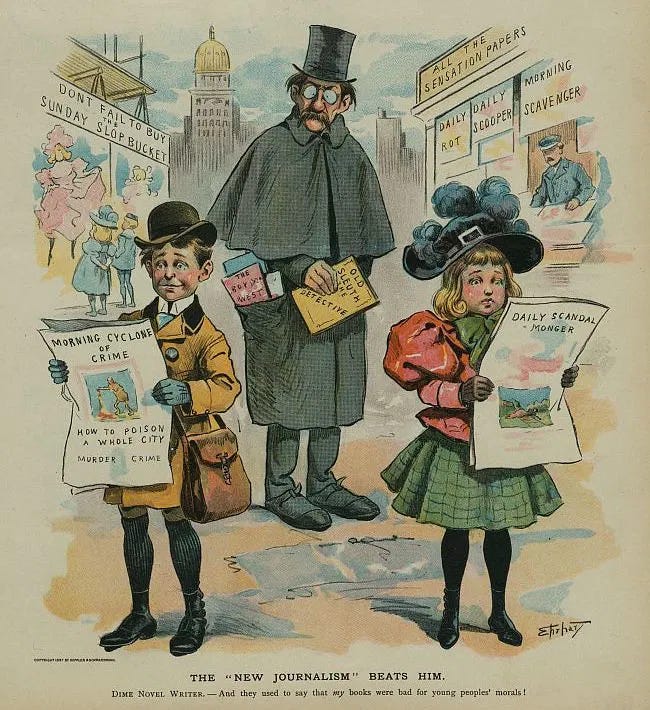
Orwell’s 1984 is waved like prophecy, a shorthand for doom. Telescreens watching, Thought Police listening, history erased and rewritten, Room 101 waiting for the unfaithful. All of it feels uncomfortably near when disinformation churns and courts bow. But prophecy is the wrong frame. 1984 was a warning, not a manual. Its power is in showing what happens when fear and apathy close every door. That is not our fate. It cannot happen here in 2025 America, not because the dangers are distant, but because they are seen, named, and resisted. The line holds only if we hold it, and we will.
Why Orwell’s World Was Total
Orwell’s Oceania was not just authoritarian, it was sealed shut. Surveillance pressed into every corner, seeping through walls and wires. The telescreen was more than a device, it was an eye that never blinked, a voice that never stopped. It glowed in your living room and burned into your mind, teaching you to police your own thoughts before anyone else could. Even silence became incriminating. Thought itself was dangerous. Privacy was not simply stripped away, it was unthinkable.
The press was no press at all. There were newspapers, broadcasts, bulletins, but they carried no voice but the Party’s. Every headline was rewritten, every sentence edited to fit the line of the day. Information did not flow in debate or exchange. It poured downward from a single mouth, a monologue masquerading as news. Truth became the reflection of fear. People did not read to learn but to survive.
There were no networks beyond the state. The natural webs that let people gather were either absorbed, broken, or forbidden. Unions, churches, clubs, study groups, even friendships. No pulpits rose without permission. No circles of trust lasted long before infiltration. Solidarity was criminal unless it was solidarity with Big Brother. Isolation was the true infrastructure.
Memory itself was colonized. History was not recorded, it was manufactured. The Ministry of Truth turned each day into a workshop where yesterday was dismantled and rebuilt. Old newspapers were shredded, photographs altered, names deleted as if they had never lived. Archives did not preserve; they erased. The past had no substance beyond the Party’s decree. What you remembered did not matter. What the Party declared became real. Reality itself was provisional, flickering, vanishing as soon as it contradicted the line.
Why Our World is not Airtight
Our world is not sealed. Surveillance grows, but it does not close every door. Screens track, cameras watch, data flows into vast warehouses, yet cracks remain. Whistleblowers leak. Journalists expose. Citizens record. A single image can escape a thousand filters. Noise floods the system, but noise is not silence.
The press still breathes. It may be weakened, bought, attacked, or maligned, but it is not extinguished. Local papers still publish obituaries and expose corruption in city halls. Independent outlets break stories the giants miss or bury. Investigators gather documents, podcasts reach millions, community radio persists. The Party in Oceania had one voice. Today there are millions. That chorus may be messy, divided, even contradictory, but it is proof that no single mouth controls the story.
Networks still grow beyond the state. Unions still strike. Faith groups still meet. Community centers still organize food banks, protests, legal defense. Neighborhood groups rally around fires, floods, elections. Students form associations. Veterans gather and speak. Some align, some disagree, some fracture, but the very fact they exist means the state does not own all solidarity.
Memory survives. Archives are digitized and copied. Court records remain accessible. Screenshots circulate before deletions land. Photographs travel across continents in seconds. Witnesses record testimony that cannot be unspoken. Governments can stall, redact, or distort, but they cannot erase every trace. The past leaves fingerprints everywhere, stubborn marks that resist even the most powerful scrub.
Authoritarianism demands uniformity. Our world refuses it. What we live in is fractured, chaotic, unfinished. That disorder, frustrating as it is, is the shield. The fracture is the protection. The noise itself is the refusal. The loop cannot close because too many cracks cut through its walls.
What It Takes to Keep It That Way
Cracks do not hold themselves open. They have to be widened. If we want to keep the loop from closing, we must tend to the fractures like fire, feeding them so they do not go out.
It takes defending the press. Not only the national papers or the nightly news, but the local reporters who sit through county budget meetings, who document police misconduct in small towns, who ask questions when no one else shows up. Keeping them alive is not an act of charity, it is the maintenance of oxygen. Without them, silence thickens.
It takes guarding libraries and schools. These are not neutral buildings. They are memory made public, repositories where knowledge and history are meant to be accessible. When shelves are stripped or archives hidden, when lesson plans are rewritten to flatter ideology, the loop begins to tighten. Protecting these spaces means protecting the possibility of memory itself.
It takes documenting everything. Photographs, videos, testimony, records. Not just captured, but stored in places that cannot be easily erased. Backups upon backups, networks of trust, decentralized archives. Evidence is armor. It turns the lie brittle because it can be held up and compared against reality.
It takes building coalitions that cross every line. Workers, students, clergy, veterans, small business owners, neighbors. Each group carries a kind of legitimacy the others cannot. Together, they create a shield no regime can easily pierce. Breadth is protection. It is harder to erase a movement that looks like everyone.
It takes discipline in the face of fear. Nonviolent strikes, boycotts, collective refusals. Fear thrives on chaos because chaos justifies crackdowns. Discipline denies that excuse. It proves that power does not belong only to those who wield weapons but to those who refuse to be provoked into collapse.
It takes linking outward. Across counties, across states, across borders. When one community is isolated, it can be crushed. When it is connected, the cost of repression rises. Human rights monitors, interstate partnerships, international eyes; all of them widen the crack.
1984 cannot take hold if the fractures remain alive. The work is not mysterious. It is patient, repetitive, and shared until it becomes structure. Resistance is not a moment but a rhythm, carried by many, repeated until it embeds itself into daily life.
The Real Risk Isn’t 1984, It’s Apathy
The danger is not Big Brother waiting outside the door. The danger is the slow surrender that happens inside.
1984 is not imposed all at once. It arrives piece by piece, in small concessions and quiet shrugs. It takes root when lies stop shocking and start feeling ordinary, when people grow used to courts bending and leaders evading consequence, when cynicism convinces us that nothing can be done.
The telescreen does not need to watch you if you have already silenced yourself. Fear does not need a Thought Police if neighbors have stopped speaking out of habit. When resistance turns into resignation, the system wins without lifting a baton.
This is how authoritarianism spreads: not only through force, but through fatigue. Silence grows contagious. Each person who gives up makes it harder for the next to hold on. The Party in Orwell’s world thrived not just on terror, but on the quiet acceptance that there was no alternative.
Our screens today are flooded with noise, not uniformity. That is both risk and shield. The risk is that the noise becomes exhausting, that people tune out, stop caring, stop fighting to discern what is true. The shield is that within the noise, truth still survives, copied, repeated, remembered. The task is not to fear the noise but to refuse apathy, to keep memory alive within it.
The real risk is not that 1984 arrives fully formed. The real risk is that we walk into it step by step, numbed by distraction, resigned to decline. The firewall is refusal, repeated until it becomes habit. Each act of documentation, each defense of memory, each coalition built, each discipline held is a spark against the dark.
1984 cannot happen here if we refuse to go quiet.
TOW
The lesson is plain. Power does not restrain itself.
When institutions falter, it is what we build together
that holds the line: numbers broad enough to be seen,
norms strong enough to be trusted,
nodes inside the system that cannot be ignored.This is not theory.
It is the hard, patient work of keeping the cracks open.
Oceania was total because it allowed no cracks.
Our defense is to widen them
until they cannot be sealed.
1984 cannot land herebecause we will not leave the field empty.
ETHER
And the desert hums its truth. The Party wanted silence, a closed loop where thought itself dissolved. What we live in is noise, fractured, messy, ungovernable. That noise is the shield. From it comes memory, carried and copied, refusing to vanish. Out of the static comes flame, the ember that outlives ashes. What terrifies them most is not control lost in an instant but control that cannot ever be total. The fire does not go out. It moves from hand to hand.
It survives.
“The ‘New Journalism’ Beats Him (1897)” artwork was pulled from https://pdimagearchive.org We suggest this article: Yellow Journalism: The “Fake News” of the 19th Century