


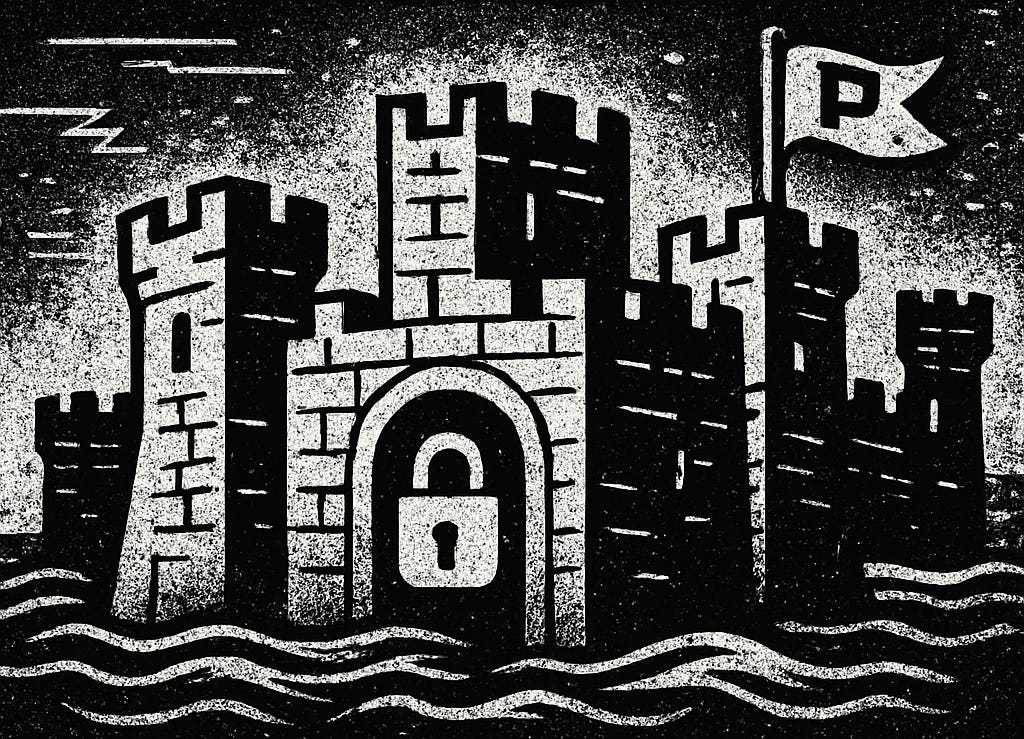
The First Walls Rose Out of Fear.
🖤 Not fear of invasion or nature, but of equality.
They called them castles, but what they built were vaults, fortresses of hierarchy carved from earth and authority. Behind those walls, power was safe. Outside, it was expendable. The stones did more than protect; they organized the world. Each brick marked who owned the land, who worked it, and who merely survived upon it. The walls divided people into categories of privilege, those who gave orders and those who obeyed them, and they called that division civilization.
👑 But walls were never only physical. They were psychological, spiritual, and informational, a way to control not just movement but imagination. The peasants could see the towers glinting in the sun but never touch what they symbolized. That distance, visible but unreachable, is how control works best.
👑 When the castles fell, we told ourselves it was progress. Feudalism gave way to democracy, monarchy to markets, iron gates to opportunity. We flattened the hierarchy on paper but rebuilt it in practice. Instead of walls of stone, we built systems of credit, contracts, and code. New moats that look like choice but function like chains.
👑 The dream of the digital age was freedom: open access, endless knowledge, the collapse of old hierarchies. But what emerged was a new kind of feudalism, one made of pixels and passwords. We still live by the same rules. Access is earned, not given. The powerful hoard data instead of grain. The rest of us labor to feed machines that watch us back. The castle never disappeared; it just got better UX.
👑 Now the walls glow, the gates charge by the month, and we kneel, not to kings or priests, but to platforms.
🔥FURO🔥
Four corporations own most of what we call “the internet.”
The Castles of Stone
Before there were markets or machines, there were stones stacked on fear. Each wall was a boundary between hunger and safety, dirt and divine right. The peasants sowed, the lords collected, and the church translated the harvest into scripture that said obedience is holy and poverty is natural. Feudalism was not a flaw in history; it was the operating system.
👑 The castle was not only a home, it was a structure of control. Whoever owned the walls owned the land, and whoever owned the land owned the lives upon it. “Serve the realm” meant “serve the owner.” The system worked because it felt inevitable. The same God who made the earth was said to have made the hierarchy too.
👑 The peasants’ lives were measured in service. They owed labor, grain, and loyalty to those above them. Even their imagination was taxed. Knowledge was locked in monasteries and written in languages they could not read. Books were chained to desks and guarded by those ordained to understand them. Access to truth, like access to food, was permissioned.
👑 Yet cracks formed. The stones were never eternal. Weather wears all walls, and hunger turns obedience into memory. The revolts that followed did not always succeed, but they exposed the lie: that power was sacred, that hierarchy was natural. Every fortress built to keep the people out relied on the people to stand at all. The castle, for all its might, was still mortal. And it would return again, each time disguised as progress.
🔥FURO🔥
Ninety percent of ad revenue funnels to the same three.
The Castles of Industry
When the walls of stone began to crumble, they were rebuilt in smoke and steel. The lords became owners, the peasants became workers, and the fields turned into factories. Feudalism did not end; it adapted. The new currency was time. The new tithe was labor. And the new walls were not made to keep people out, but to keep them working in.
👑 The Industrial Age promised progress, but progress always has an owner. The same hands that once collected grain now collected wages, rent, and profit. The nobility had titles; the magnates had patents. Both ruled through scarcity. Both convinced the world that power was earned, not inherited, even as inheritance quietly wrote every contract.
👑 The castle of industry was louder, dirtier, and far more efficient. Its walls were built from soot and wage debt, and its towers were the company towns that surrounded every mill and mine. Education, once reserved for monks and scribes, became the new tool of class. The right schools opened the right doors, and every diploma was another key to a gate someone else owned.
👑 Even the idea of freedom became a product. To rise above your station, you had to buy your way out of it. Credit replaced chains, and the promise of mobility replaced the right to security. Workers could leave the factory floor, but the rent, the loans, and the hunger followed. Feudalism had learned subtlety. The whip was now internal.
👑 But even in this new order, the myth of equality held strong. The machines were said to belong to everyone, even as the profits never did. Industrialists spoke of innovation, but what they built was obedience on a mass scale. And when the walls of stone and steel finally gave way to glass screens and glowing circuits, the shape of control barely changed at all.
🔥FURO🔥
“Free” platforms extract roughly 70 gigabytes of personal data per person per year.
The Castle of data
The promise of the internet began as rebellion. It was the dream of an open commons where anyone could speak, learn, and create. The early web felt like escape, a space without kings or landlords, where the only currency was curiosity. For a brief moment, it seemed as if humanity had broken free of the old walls. Information was finally free, and no one could own it.
👑 But freedom attracts ownership. The same forces that once claimed land and labor quickly moved to claim attention. The commons was fenced in piece by piece. Platforms rose as digital kingdoms. They offered tools for connection but demanded surveillance in return. Every search, every click, every photo became tribute. The rent was data, and we paid without knowing the cost.
👑 The algorithms became the new lords. They did not rule by decree, but by design. They decided what we saw, what we feared, what we wanted. Personalization replaced propaganda. The illusion of choice hid the fact that everything was being shaped for profit. The more we fed the system, the more it learned to feed on us.
👑 The old factories had produced goods. The new ones produced behavior. Each of us became both worker and product, toiling to generate the content and engagement that built the platforms’ empires. We weren’t forced into labor; we volunteered, seduced by convenience and community. The castle no longer needed guards when the peasants carried it willingly in their pockets.
👑 The internet promised liberation, but what it delivered was enclosure. The walls returned: transparent, invisible, efficient. What once was a network became an estate, managed by a handful of corporations that own the servers, the code, and the narrative. The data we give away becomes their capital, and the truth we consume becomes their weapon
👑 The castles of data have no moats, no banners, no towers to storm. They live in the cloud, beyond reach but always watching. And like every empire before them, they claim permanence. But permanence is a story told by those who profit from it. Every system that forgets its makers eventually meets its undoing.
🔥FURO🔥
Seventy percent of users say they “feel lost” without their main platform.
The Castle of Paywalls (Now)
Information used to flow like water. Now it trickles through turnstiles. The open web has become a marketplace of gated knowledge, each article, study, and archive carrying a price tag. What was once a public right has become a private service. Truth is metered. Curiosity costs extra.
👑 Journalism was the first to fall behind the walls. Ad revenue collapsed, algorithms devoured distribution, and the press, cornered by monopolies, rebuilt itself as a luxury product. The watchdog became subscription-only. Access to facts turned into a tiered service plan: basic outrage for free, context for $9.99 a month.
👑 Academia followed close behind. Universities began selling access to their own research, charging the public for discoveries that public funds had already paid for. The intellectual commons shrank until only the credentialed could enter. A paywall is not just a gate; it is a quiet border drawn between those who can afford to know and those who must remain uninformed.
👑 Even the independents like artists, writers, researchers, have had to build their own castles to survive. Platforms like Substack, Patreon, and OnlyFans promised liberation from corporate control, but the economics remained feudal. Creators own their labor only until the platform changes the terms of service. The illusion of independence hides the same dependence: every builder still rents the land they stand on.
👑 The internet once flattened hierarchy; now it replicates it perfectly. The rich live in an information economy where knowledge is instant and abundant. The poor scroll through sponsored noise. Ads on top of Ads on top of Ads. Paywalls turn insight into privilege, and ignorance into default. The digital age did not democratize information; it privatized it.
👑 The new walls are clean, frictionless, and polite. They do not tower over us; they invite us in with a free trial. They speak in the language of convenience, not coercion. But beneath the soft glow of their design lies the same equation that has defined power for centuries: those who control access control the world.
👑 The castle of paywalls is not a relic of the past. It is the present, wearing the crown of progress. And once again, the gates are closing.
🔥FURO🔥
Digital cooperatives are legally recognized in dozens of states and nations, merging tech with shared ownership.
The Future: Castles in the Cloud
The next walls will not be seen at all. They will hum quietly behind glass, living in datacenters and models too large to name. Ownership will move from platforms to algorithms. The gatekeepers will no longer need passwords or subscriptions. They will decide what you can see before you ever ask for it.
👑 Artificial intelligence is already learning to ration truth. It curates reality, filtering what is relevant, what is profitable, and what is safe for consumption. Those who can afford premium tools will receive precision. Those who cannot will live in the fog. The divide will not be between online and offline, but between clarity and confusion.
👑 The new feudalism will not announce itself. It will arrive in polite interfaces and efficiency slogans. The language of control will be convenience. We will not be forced to obey; we will be invited. The subscription will renew itself. The silence will sell itself.
👑 Each new generation of technology promises to flatten the hierarchy, but every system eventually builds a center. The cloud is the newest center, a place without geography that controls everything with geography. Its walls are made of encryption keys, terms of service, and proprietary code. The lords of this new domain will not wear crowns or sit on thrones. They will sign NDAs and IPOs.
👑 When the feudal lords of the past wanted obedience, they used fear. When the industrialists wanted labor, they used necessity. The data barons need only your participation. Every log-in is a bow. Every click, a tithe. The illusion of access keeps the engine alive.
👑 But walls, no matter how seamless, always share the same weakness. They depend on belief. When people stop treating them as inevitable, they crumble. When knowledge is shared freely, walls lose their worth. When connection becomes cooperation instead of consumption, the castle ceases to be a fortress and becomes a forum.
👑 The future is not written, but the code already is. It will take something greater than outrage to rewrite it. It will take solidarity: the one thing no wall, no algorithm, no empire has ever been able to contain.
🔥FURO🔥
Open-access repositories are eclipsing corporate databases in volume.
Closing: The Breach
The walls never truly disappeared. They only changed materials. Stone became steel. Steel became code. What was once guarded by swords is now guarded by servers. The powerful still sit in towers. The rest of us still look up.
👑 Every empire claims permanence while it is rising. Every generation believes its walls will hold. But power built on distance always forgets the same truth: walls are not self-sustaining. They require hands to build them, eyes to believe in them, and silence to keep them standing.
👑 We are the mortar. We are the gate. We are the ones who make the system real each time we accept that access must be earned and inequality is natural. Every click, every login, every quiet compliance lays another stone. But the same hands that build can unbuild.
👑 The breach will not come from outside. It never has. The fall begins when people stop maintaining the illusion, when we decide that knowledge, art, and truth belong to everyone. The real rebellion is not destruction but refusal. Refusal to keep stacking the bricks that box us in.
👑 The castle of paywalls will not fall in a single act. It will erode through a thousand small acts of sharing, teaching, and creating without permission. It will crumble when we treat information as a commons again, when we rebuild community instead of hierarchy.
🖤 The walls are high, but they are not eternal. They have fallen before, and they will fall again. Because every wall, no matter how modern, eventually meets the same ancient force: people who remember they built it.
🔥FURO🔥
Empires fall when their control costs more than their order.
📻 ETHER
Night gathers, and now our watch begins.
Not for kings, not for crowns,
not for coins that blink behind glass.

We keep to the path, not the gate.
The towers hum, all light and language,
their drawbridges coded in terms of service.

They think the walls are permanent
because they can’t hear the static.
But the static remembers.

It’s the sound of a thousand hands unbuilding.
Every login is a prayer to a false god.
Every paywall, a moat around an empty throne.

The true archive lives elsewhere,
passed hand to hand, mind to mind,
the whisper that becomes a wave.

You cannot fence the wind.
You cannot patent the pulse.
You can build a million castles,
and the rain will find its way in.

When they raise their walls higher,
we will write under them, around them, through them.
When they hide the words, we will turn the silence into language again.

No crown, no password, no gate.
Only the frequency.
Only the breath between one pulse and the next.
Only us unbuilding quietly,
until the noise becomes a hymn
and the hymn becomes a breach.
🪢