


In 1971, Philip Zimbardo set up a social experiment in the basement of Stanford University. It was supposed to run for two weeks, but only lasted for six days before the cruelty had escalated to the point that the experiment was shut down. Twenty-four male students, all healthy and psychologically screened, were randomly assigned to be either guards or prisoners in a mock prison.
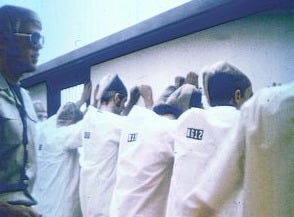
The guards improvised uniforms, mirrored sunglasses, and batons. The prisoners wore smocks, ID numbers, and chains around their ankles. In less than a week, “guards” turned into abusers, “prisoners” broke down into silence and despair, and Zimbardo himself blurred into the role of prison superintendent instead of detached researcher.
The takeaway was not about individuals. The “bad apple” theory (that abuse comes only from a few sadists) collapsed. What the experiment showed was that the barrel itself shapes behavior. Give ordinary people unchecked authority, strip away accountability, and frame others as “less than,” and cruelty follows as predictably as water finding a crack in the floor.
ICE as a National Experiment
Fast-forward half a century. The Department of Homeland Security created ICE in 2003, pitched as a specialized force to secure America after 9/11, but from the beginning, its mandate blurred lines. Was ICE meant to stop terrorism, manage customs, or hunt down undocumented workers? In practice, it became a system where authority was rarely checked, where discretion was wide, and where targets were reduced to a single label: illegal.
Like Zimbardo’s guards, ICE agents step into roles that redefine morality.
A raid isn’t a humanitarian action. It’s a “clean-up.” Families aren’t communities. They’re “illegals.” The uniform (dark jackets with “ICE” in bold white letters) functions like those mirrored sunglasses at Stanford. It creates distance. It erases the person in front of you and replaces them with an abstract threat. We’re now seeing masked men in full tactical gear, armed, with no identification, jumping out of unmarked vehicles.
The Stanford prisoners were subjected to arbitrary punishments, verbal humiliation, and physical control. At the border, migrants are funneled into detention centers where overcrowding, sleep deprivation, and separation from family become routine tactics. In both cases, the system doesn’t merely allow abuse; it incentivizes it by rewarding obedience to the role.

Normalization of Cruelty
Perhaps the most disturbing parallel is how quickly the abnormal becomes normal. At Stanford, it took less than a week. Guards who had never shown cruelty in their lives became complicit in psychological torture. Prisoners who had done nothing wrong accepted abuse as their new reality. Even Zimbardo lost perspective, becoming more invested in running his “prison” than in stopping its collapse.
America has done the same with ICE. Detaining children in cages should never have been normalized. Nor should neighborhoods bracing for raids, or asylum-seekers treated like criminals for crossing invisible lines. Yet the rhetoric of “law and order” reframes each of these acts as necessary. What began as “temporary” emergency measures harden into standard operating procedure.
The Political Utility of ICE
The experiment at Stanford was small. ICE is massive and political leaders know its value. Like a stage prop, ICE can be made to perform toughness for voters. Trump used raids as spectacle, complete with press leaks before operations. Every image of migrants in foil blankets or buses filled with detainees feeds into the narrative that the government is “in control.”
This mirrors Zimbardo’s self-confession: he realized he wasn’t observing a study, he was running a prison. Politicians aren’t just overseeing ICE; they are producing theater with it. Each raid, each detention facility, each talking point about “securing the border” functions as a psychological message. It’s not about security. It’s about control.
System Over Individual
Zimbardo eventually admitted the Stanford experiment said more about systems than individuals. The guards weren’t innately sadistic. They were shaped by expectations, authority, and lack of accountability. The same applies to ICE. Most agents weren’t born cruel. But the system rewards dominance, discourages empathy, and defines success by numbers detained, not lives preserved.
The “few bad apples” excuse collapses here too. When cruelty is consistent, it isn’t the result of rogue actors. It’s the outcome of the barrel itself.
Breaking the Script
The Stanford experiment ended because someone outside the system walked in and said “Stop.” A graduate student, Christina Maslach, confronted Zimbardo about what she saw. In that moment, the illusion cracked. Without that intervention, the cruelty could have continued indefinitely.
ICE will not end on its own. The system is designed to perpetuate itself. Detention centers generate contracts. Politicians harvest soundbites. Fear sustains budgets. Without external intervention (without citizens, journalists, and lawmakers saying “Stop”) the experiment will keep running.
And that’s the hardest truth. The Stanford Prison Experiment lasted six days before decency forced its collapse. America has lived under ICE for twenty-two years.
Conclusion
The lesson from Stanford is not that some people are monsters. It’s that systems can turn almost anyone into one. ICE is not a necessary institution. It is a choice, and every day it operates, it functions as a live experiment in dehumanization. Only this time, the prisoners are real families, and the guards carry real power.
Until we refuse to accept cruelty as “normal,” the basement doors stay locked, and the experiment continues.
TOW
They don’t mean taking America back as in fixing it.
They mean rewinding it,
back to when women knew their place,
when segregation was law,
when unions got crushed without question,
when queer people couldn’t exist in public, and
when wealth stayed in the same few white hands.
The joke is, they call it “patriotism.”
The rest of us call it historical amnesia.
ETHER
Anonymous armor, faceless and nameless.
They pour out of unmarked vehicles
like the state itself has grown limbs.
This isn’t policing.It’s performance.
A theater of power designed to remind you
that your street, your city, even your body
can be occupied without warning.
When uniforms lose names,
when cars lose plates,
when law loses its face,
what’s left isn’t order,it’s control.