

Receipts Box:
WHAT HAPPENED?
Trump used “Liberation Day” to brand two unrelated actions: a sweeping tariff program and a federal intervention in Washington, D.C. with National Guard troops and temporary control over the Metropolitan Police Department. The label collapses economic policy and domestic militarization into one patriotic storyline.
Part I: “Liberation Day” for tariffs
On April 2, 2025, the White House announced new tariffs under IEEPA and called the day “Liberation Day.” The package set a baseline 10 percent tariff and “reciprocal” add‑ons for deficit countries, later extended and modified by follow‑on orders and fact sheets. Public messaging on X also used the Liberation Day framing.
Reality check. Tariffs are taxes on imports that are largely borne by U.S. consumers and businesses through higher prices. That is not a partisan take. It is the consistent conclusion of nonpartisan budget and academic work. The Congressional Budget Office and independent modeling estimate notable price level increases from broad tariffs
Part II: “Liberation Day” in D.C.
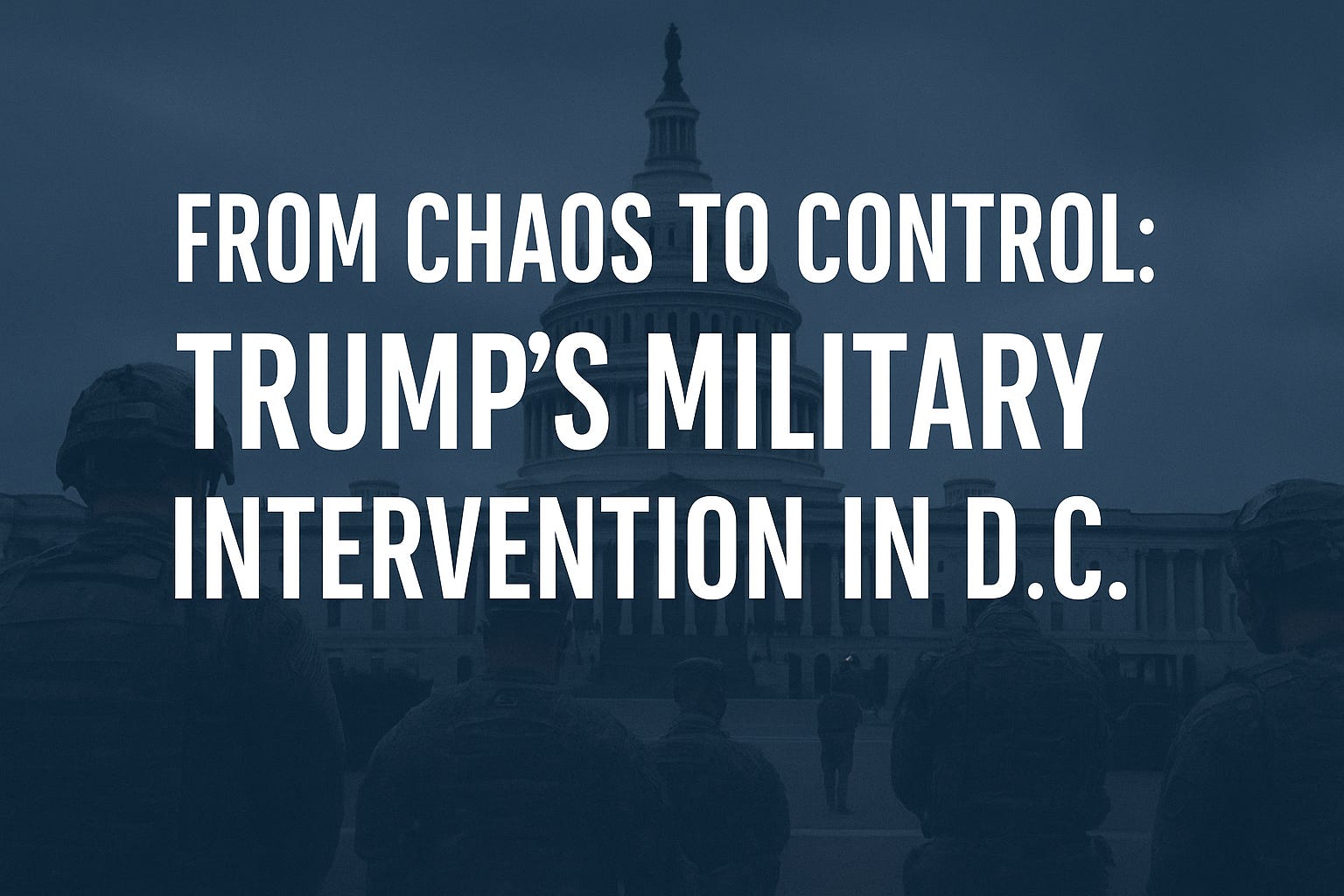
On August 11–12, 2025, Trump declared what he called a public‑safety emergency in Washington and announced National Guard deployments and federal control of D.C.’s police. He publicly labeled it “liberation day” for the capital. Coverage by Politico, Axios, AP, and others documents the scope, rhetoric, and pushback, including concerns that local crime data did not match the crisis narrative.
Why he can do it in D.C.
The D.C. National Guard is unique. Unlike state Guards, it sits under federal control. By statute and executive delegations, the President, through the Defense Department and the Secretary of the Army, can activate and direct the D.C. Guard. The Home Rule framework leaves D.C. with limited recourse, which is why statehood advocates point to this episode as Exhibit A.
What the law still limits:
Analysts note the President can activate the D.C. Guard and play a dominant role in local policing during a declared emergency, but there are time limits, procedural checks, and litigation risks. ABC’s explainer and Politico’s legal rundown sketch the edges of this authority.
The through‑line: branding force as freedom
Reusing one word for two different actions is not accidental. Repetition creates an associative frame. Cognitive science calls this the illusory truth effect: repeat a claim or label and people rate it as more true or fitting, especially when facts are complex. Here, “liberation” gets glued to both a tariff regime and soldiers on city street
Readers flagged the Orwell echo. That is apt. “War is peace. Freedom is slavery. Ignorance is strength.” Orwell’s point was not poetry. It was method. Redefine terms until power looks like protection and emergency looks like normal.

What the numbers say vs. what the slogan sells
D.C. safety trend:
Local violent crime fell year over year, even as the White House described “crime, savagery, filth, and scum.” Reporters and officials highlighted the gap between rhetoric and data in the days surrounding the takeover.
Tariff impact:
Nonpartisan analyses find broad tariffs lift price levels for consumers and raise input costs for firms. That is the opposite of immediate relief on grocery bills or rent.
Why the same word matters
Using “Liberation Day” twice does three things.
Blends policies.
Economic nationalism and domestic force feel like parts of one campaign, not separate debates that need separate scrutiny.
Shifts the burden.
If you object to either tariffs or troops, you are cast as opposing “liberation.” The frame becomes a loyalty test, not a policy question.
Short‑circuits timelines.
Tariffs are long‑horizon costs. Guard deployments are short‑horizon shows of power. The label erases that difference, which helps claim “wins” fast while costs arrive later.
The civics underneath
D.C.’s structural vulnerability.
The capital’s lack of statehood and unique Guard chain of command make rapid federal intervention far easier than in any state. Calls for statehood predictably surged after the move.
IEEPA and tariffs.
Courts and states are already testing whether IEEPA supports sweeping peacetime tariff architecture. The administration has adjusted and extended rules by executive action while litigation proceeds.
TOW
Call it what it is.
The word is working as camouflage.
The tariffs are a consumer tax dressed as independence.
The troops are control dressed as safety.
The repetition is the trick.
You hear “liberation” enough times and stop asking who is being freed, and from what.
What to watch next
Price pass‑through:
How much of the tariff cost shows up on receipts in Q3 and Q4 consumer data. CBO and independent labs say it will. We should track it. Congressional Budget Office
Scope creep in D.C.:
Whether Guard missions expand, how long federal control of MPD is extended, and what courts say about the emergency rationale.
Language drift:
Whether “Liberation Day” gets attached to additional actions, which would confirm the strategy is repetition, not coincidence.
ETHER:
“Liberation is not a flag on a mast. It is the hand on the switch deciding when the lights go dark. Call it twice and the word becomes a leash and the one holding it is not you.”