


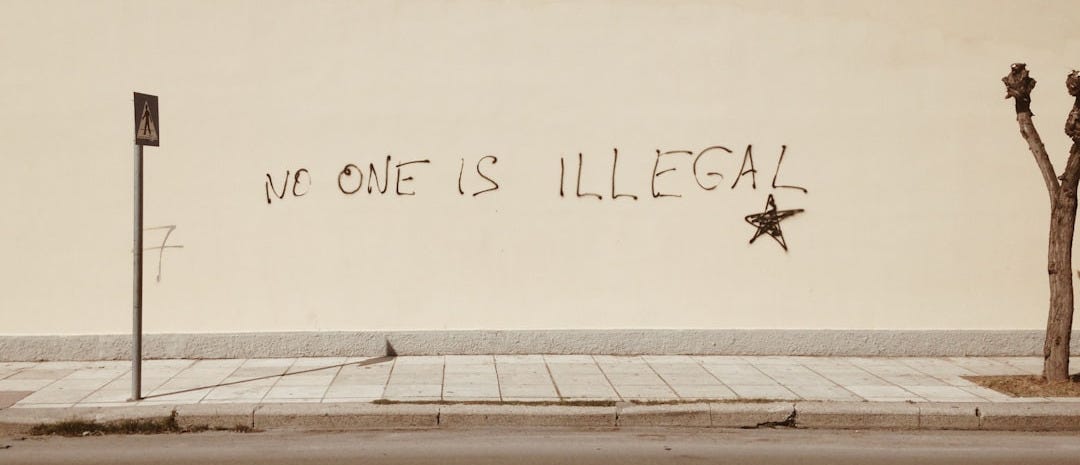
It’s a word built to erase.
Not “you crossed without papers.” Not “you broke a law.”
The word makes the person the crime.
“You are illegal.”
That trick turns a mother into a case file, a worker into contraband, a child into a target. It is the language of cages and deportations, the way a system strips humanity and hides behind paperwork.
✦ Here’s the truth: this word is not ancient. It’s not natural. It was invented. For most of U.S. history, people walked in without passports, without visas, without papers. Europeans didn’t check in with customs before they colonized. No one called them “illegal.” The word only appeared when lawmakers wanted to draw a line, not against all immigrants, but against specific ones.
“No one is illegal” isn’t chaos. It’s clarity. It refuses to let the state mask conquest with bureaucracy. It forces us to see what’s in front of us:
People, not paperwork.
The Invention of “Illegal”
For most of U.S. history, there was no such thing as an “illegal immigrant.” The ports of New York and Boston didn’t have lines of agents stamping passports. Ellis Island only opened in 1892; before that, arrivals were largely unregulated if you were European. Colonists stepping off ships in the 1600s weren’t “illegal.” They were settlers. Legality wasn’t even a question for them.
✦ The word “illegal” only enters the American vocabulary when lawmakers needed a tool to exclude.
1882: The Chinese Exclusion Act.
Chinese laborers who had built railroads and worked mines across the West became scapegoats during an economic downturn. Congress barred them from entry and citizenship, the first time federal law excluded a group based solely on race and nationality.
1924: The Johnson-Reed Immigration Act.
Lawmakers imposed racial quotas favoring northern Europeans, capping southern and eastern Europeans, and banning Asians outright under eugenic theories of “protecting American stock.”
1929: Criminalization of the border.
Congress made unauthorized entry from Mexico a federal crime. Generations of workers who had moved back and forth seasonally were suddenly rebranded as “illegals.”
From the start, “illegal” was not neutral. It was targeted. It was code. It marked out who was welcome and who was expendable.
The Double Standard of Legality
If “illegal” were a neutral category, it would apply evenly. But in America, it has always been applied selectively: to the powerless, not the powerful.
✦ Settlers were never illegal. Europeans landed on Indigenous shores without permission, claimed land, enslaved people, built colonies. Instead of being called “illegals,” they were called pioneers.
✦ Enslaved Africans were never immigrants. They were trafficked as property. Their presence was not “illegal.” It was legal, enforced, and profitable. Even after emancipation, their citizenship was contested in law but never labeled “illegal.”
✦ Corporate exploitation is never illegal. Companies move money across borders every day, hide profits offshore, import goods from sweatshops. It’s called globalization, not illegality. When workers cross borders, they’re criminalized. When corporations do, they’re subsidized.
“Illegality” is not about breaking laws. It’s about who has the power to write them.

Borders on Stolen Land
The sharpest irony of “illegal immigrant” is the ground itself. The United States rests on land that was never freely given. It was taken by conquest, fraud, forced removal, and broken treaty after broken treaty.
The Trail of Tears (1830s):
Cherokee, Choctaw, Creek, Chickasaw, and Seminole nations were forced at gunpoint from their homelands in the Southeast. Thousands died on the march. Their only “crime” was standing in the way of white settlers who wanted cotton land.The Black Hills (1870s):
The Sioux were guaranteed sovereignty in the Fort Laramie Treaty. When gold was found, the U.S. ignored the treaty and seized the land. A century later, the Supreme Court admitted the theft but offered money, not the land itself. The Sioux refused.Termination Acts (1950s):
In the name of “integration,” the U.S. dissolved the legal status of dozens of tribes and seized millions of acres. Native sovereignty was erased by a congressional vote.
✦ None of this was ever called “illegal.” Why? Because the law was written by those who did the taking. “Legal” and “illegal” were not descriptions of justice. They were labels pinned on whoever held less power.
✦ And yet, the same state that committed dispossession now uses that land as the foundation for criminalizing others. Borders themselves are colonial inventions, drawn and redrawn through conquest. Indigenous people understand this better than anyone: “We didn’t cross the border. The border crossed us.”
✦ That is the hypocrisy at the core. To criminalize a worker fleeing poverty in Mexico or a refugee fleeing violence in Central America as “illegal” while living on land taken from Cherokee, Lakota, and countless others is to double down on conquest. It is not just about migration. It is about power deciding who belongs and who does not, while never answering for its own theft.
“Illegal” doesn’t erase that history. It extends it.

Law Is Not Morality
The defenders of “illegal” lean on the law as if it were unshakable truth. If it’s illegal, it’s wrong. If it’s legal, it’s right. But history makes a mockery of that claim.
Slavery was legal.
For over two centuries, human beings were bought, sold, whipped, and worked to death under the full protection of U.S. law. Abolitionists were the “criminals.” Escaped slaves were hunted under the Fugitive Slave Act of 1850, and those who helped them were prosecuted.Segregation was legal.
Plessy v. Ferguson (1896) enshrined “separate but equal” as the law of the land. Black citizens who resisted were jailed, beaten, or worse. Rosa Parks was not just brave; she was “breaking the law.”Marriage bans were legal.
Until 1967, interracial marriage was outlawed in many states. Until 2015, same-sex marriage was illegal nationwide. To marry across those lines was to be a lawbreaker.Genocide was legal.
Native children were forced into boarding schools to erase their culture. Their families had no legal recourse. The law itself carried out the violence.
✦ What is “illegal” has always been shaped by power, not justice. And what is “legal” has often upheld injustice.
✦ That is why “illegal immigrant” carries such poison. It pretends to be neutral, when it is as historically loaded as “fugitive slave” or “colored only.” It masks political choice as natural truth. It weaponizes the law to strip away humanity.
Legality is not morality. A law can be passed overnight, but justice takes generations to fight for.
☲ The Frequency
“No one is illegal” is not chaos. It is clarity. It cuts through the trick the state plays when it confuses paperwork with humanity.
✦ The category “illegal” was invented to exclude, applied selectively to the vulnerable, and enforced on land already stolen. It has never been neutral. It has always been code. Code for Chinese laborers in the 1880s. Code for Jews and Italians in the 1920s. Code for Mexican workers in the 1930s. Code today for anyone who does not fit the picture of whiteness America prefers.
✦ Borders move. Laws change. What is “illegal” one decade is legal the next. But humanity does not shift with statutes. People are not paperwork.
✦ The truth is sharper: to call a person “illegal” on stolen land is conquest pretending to be order. It is history doubling back on itself, demanding silence where there should be justice.
No one is illegal because illegality itself is not an identity. It is a weapon. And weapons can be broken.
Excellent article… very well laid out! “ No one is illegal because illegality itself is not an identity. It is a weapon.” 👍