Stealing the Table
How a Trumpified Rockwell Distorts ‘Freedom From Want

I. The Image That Should Not Exist
The first thing we feel is the wrongness of it.
You don’t need art history to sense it.
You don’t need politics either.
Something in the frame just bends the wrong way.
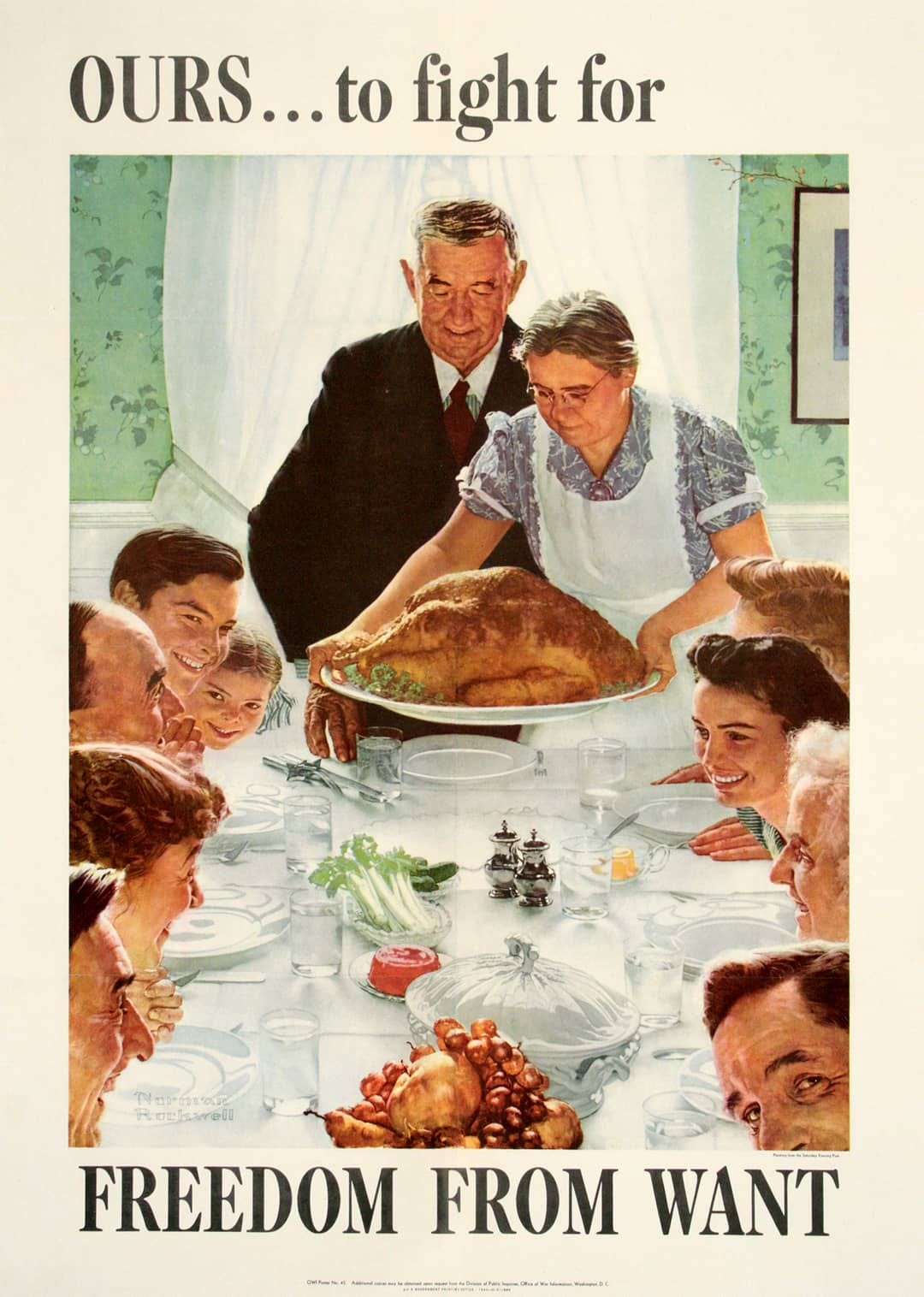
Rockwell painted a moment of quiet belonging.
No hierarchy.
No power hovering over the table.
Just a family doing the simple, steady work of showing up for one another.
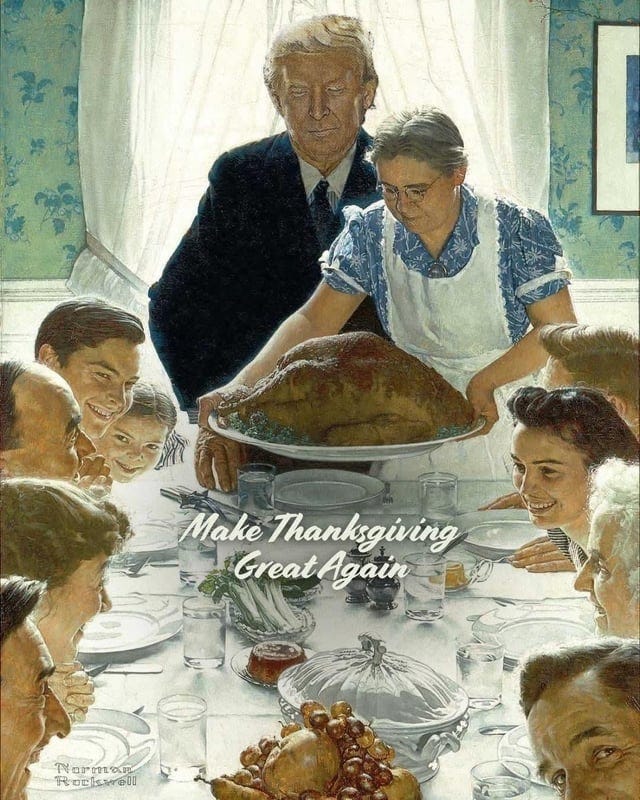
Then someone drops Trump’s face into the scene, and the whole picture tilts.
The elder isn’t a grandfather anymore.
He becomes a presence.
A watcher.
A figure meant to be obeyed, not loved.
The room stops feeling communal and starts feeling staged.
It’s not about liking or hating Trump.
It’s about the edit rewiring the meaning of the moment.
Rockwell painted a table that belonged to everyone.
The edit turns it into a table owned by one man.
And once you see that shift, you can’t unsee it.
The warmth drains out.
The center collapses.
The image becomes a billboard for loyalty instead of a picture of community.
That’s the theft.
Not the face swap, but the meaning swap.
The quiet promise of “enough for all” gets replaced with a slogan dressed as nostalgia.
And whoever made it knew exactly what they were doing.
II. What Rockwell Was Actually Painting
Rockwell was not painting power.
He was painting ordinary life at a moment when ordinary life felt fragile.
It was 1943.
The country was rationing sugar, rubber, meat, gas.
Families had empty chairs at the table because sons and brothers were overseas.
Factories ran night shifts.
Wages were thin.
Anxiety was the air.
Freedom From Want was never a brag.
It was a promise.
A reminder of what the country owed its people once the war was done.
Look at the faces in the original painting.
No one is performing.
No one is posing for newspapers.
No one is center stage.
The grandfather is not the “head” of anything.
He is simply an anchor in the room.
He belongs to the family the same way the turkey belongs to the table.
He is part of the ritual, not the reason for it.
The mother sets the turkey down with both hands.
There is no spectacle in it.
It is work.
Daily, necessary, unglamorous work.
The kind of labor that never gets headlines but keeps a country alive.
The rest of the family leans in.
Not toward the elder, not toward authority, but toward each other.
The center of the image is us, not him.
That is the whole point of the Four Freedoms.
They were collective.
Shared.
A vision of stability that did not rely on a strongman or a mythic past, but on common responsibility.
Rockwell painted the idea that democracy is a table everyone has a place at, and that the feast is only real if the invitation is universal.
It was not nostalgia.
It was a declaration of obligation.
A country that offers “freedom from want” is a country committed to making sure no one at that table goes hungry, invisible, or forgotten.
You lose all of that the second you replace the elder with a man who demands loyalty instead of offering belonging.
III. Bulosan’s Essay and the Real Heart of the Image
Most people know the painting.
Almost no one knows the essay that came with it.
Rockwell gave the picture.
Carlos Bulosan gave the meaning.
He was a Filipino immigrant who lived through hunger, poverty, racism, strikes, police violence, and constant precarity.
He wrote from the perspective of someone who had never been invited to tables like the one in the painting.
And yet he believed in the promise behind it.
The essay is not comfortable.
It is not patriotic fluff.
It is not a celebration of abundance.
It is a confrontation.
Bulosan writes about the people who build the country, the ones who labor without recognition. Factory workers, miners, field hands, soldiers, migrants, poor families barely surviving. He calls them out one by one. He names them as the foundation of the democracy he still believes can exist.
He says freedom is not an idea.
It is not a symbol.
It is not something you frame.
Freedom is food on the table.
Freedom is steady wages.
Freedom is dignity in your own country.
Freedom is not being crushed by poverty or forgotten by those in power.
He writes, “It is only when we have plenty to eat… that we begin to understand what freedom means.”
Not luxury. Not excess.
Just enough.
Enough to live without fear.
He writes about the immigrant who works twelve-hour shifts and still believes America can be home. He writes about the poor who keep faith even when the system does not see them. He writes about the promise that freedom belongs to the many, not the few.
And he warns, quietly, that a country that fails to guarantee basic security will lose itself from the inside.
This is the voice at the center of the painting.
Not the grandfather.
Not the table.
Not the turkey.
The choice is a writer naming a truth America still avoids.
A truth about want, and who carries it, and who benefits when the story is rewritten.
Putting Trump into this painting does not just distort the visual. It erases Bulosan. It erases the workers he spoke for. It erases the entire moral charge of the Four Freedoms.
The edit swaps out a message about shared dignity for a message about personal dominance.
Freedom From Want becomes Freedom For Some.
The whole soul of the piece gets hollowed out.
IV. How Authoritarian Movements Hijack Symbol
The Trump edit is not random.
It is part of a long pattern.
Authoritarian movements do not create their own symbols.
They steal the ones people already trust.
They take the familiar and twist it just enough to smuggle in a new meaning.
The whole point is to slide a new ideology under old comfort.
This is how it works.
They pick something soft.
Americana.
Family.
Tradition.
Small towns.
Holidays.
White picket fences.
Norman Rockwell.
They use it as a shell.
They climb inside the shell and push their own message through it.
And people who would never follow the raw version of their politics start nodding along because the packaging feels safe.
Rockwell painted unity.
They turn it into obedience.
Rockwell painted belonging.
They turn it into “belonging for the right people.”
Rockwell painted the shared promise of a stable country.
They turn it into nostalgia for a country where some people had no rights at all.
The strategy is simple.
Find a symbol rooted in collective care.
Replace the collective with a leader.
Replace responsibility with loyalty.
Replace shared dignity with hierarchy.
That is the theft.
And it works because the symbol creates a shortcut in the mind.
You see the familiar form, and your guard drops before the message hits.
It is the political version of wearing someone else’s skin.
A disguise built out of cultural memory.
The Trump edit does not just add his face.
It rewrites the invitation.
The table is no longer open.
It is conditional.
It is branded.
It is owned.
This is the same playbook used whenever strongman movements want credibility they did not earn.
They do not build symbols.
They hijack them.
And once you see the swap, you can see every other swap too.
The flags, the slogans, the rewritten history, the patriotic aesthetics pumped over messages that have nothing to do with freedom.
The trick is old.
The result is always the same.
A shared symbol becomes a weapon.
V. Why This Edit Hits the Nerve It Does
People try to act like it is just a meme.
Just a joke.
Just “Trump’s face on an old painting.”
But even if you cannot explain it in the moment, your body knows something is off.
Here is why.
The original painting says, “Everyone belongs at this table.”
The edit says, “This table belongs to me.”
Rockwell painted a circle.
The edit turns it into a pyramid.
Look at the room again.
The light in the original is even.
No one is above anyone else.
No one is framed as the source of the blessing.
The table feels earned, communal, built by many hands over time.
Drop Trump in, and the whole energy shifts.
People are not gathering.
They are orbiting.
The moment becomes about the man, not the meal.
The grandmother’s posture turns into service.
The grandfather’s role becomes one of authority.
The family turns into an audience.
And what was a collective promise becomes a political branding exercise.
There is another layer, too.
Trump is a figure who has built his identity on grievance, purity tests, loyalty demands, and exclusion.
Putting that face into a painting about shared dignity is like pouring bleach into broth.
The image stops being about freedom from want and becomes freedom from criticism.
Freedom from accountability.
Freedom for the powerful.
Rockwell’s painting was an invitation.
The edit is a gate.
And maybe the deepest violation is this:
The Trump version treats Bulosan’s essay as if it never existed.
It wipes out the immigrant writer who spoke for workers, for the poor, for the people who never had enough.
It scrubs away the idea that freedom is a responsibility we owe one another.
The edit replaces solidarity with hierarchy.
It swaps hope for branding.
It trades a message about “all of us” for a message about “him.”
That is why it lands wrong in your chest.
It is not the face.
It is the theft.
It takes a symbol of belonging and turns it into a club.
VI. What This Says About America Right Now
The Trump edit is not just a cringe image.
It is a map of where the country is standing.
We are living in a moment where symbols are not shared anymore.
Everything gets sorted into sides.
Even the things that were supposed to be universal.
Freedom From Want was built on the idea that a country should guarantee basic security for everyone.
Not luxury.
Not excess.
Just a life without fear of hunger or poverty.
For a long time, that idea was treated as a baseline.
Not partisan.
Not controversial.
A standard for what it meant to call yourself a decent nation.
Now look at how the image is being used.
A symbol of collective care has been turned into a symbol of political ownership.
A painting about everyday people is being refitted to support a man who has always demanded loyalty over community.
It is the perfect snapshot of the fight we are in.
One side is trying to claim the entire story of America, rewrite it, and brand it as their personal property.
The other side is still trying to hold on to the idea that this place belongs to all of us, even when the system keeps failing to prove it.
The edit exposes something else, too.
A country that cannot agree on what “enough” means is a country that cannot agree on what freedom means.
If half the nation frames economic security as a luxury or a reward, the Four Freedoms become impossible to uphold.
Bulosan wrote about the people who make America run but rarely get to sit at the table.
Workers.
Immigrants.
Poor families.
People who survive on grit, not privilege.
In his version of America, freedom was a responsibility we share.
In the edited version, freedom is a product with a face on it.
That shift is the crisis.
Not Trump.
Not the meme.
The mindset.
A country that forgets how to imagine a shared future will always retreat into personality cults and branded nostalgia.
It is easier to worship a figure than to build a system that works for everyone.
The Trump edit is not the problem.
It is the symptom.
It shows a country that has forgotten who the table was built for in the first place.
And until we can see that clearly, we will keep losing the very freedom Rockwell and Bulosan were trying to remind us of.
The freedom to have enough.
Enough to live.
Enough to stand.
Enough to belong.