


“The receptivity of the masses is very limited, their intelligence is small, but their power of forgetting is enormous.”
— Adolf Hitler, Mein Kampf (1925)
It is a strange sight to see any American praise or defend Adolf Hitler. The contradiction is immediate. By the very standards Hitler used to define worth, most Americans would have failed his test. The United States he watched from afar was, in his eyes, a cautionary tale. He believed its people were a weakened and mixed population, proof that racial purity could not survive democracy.
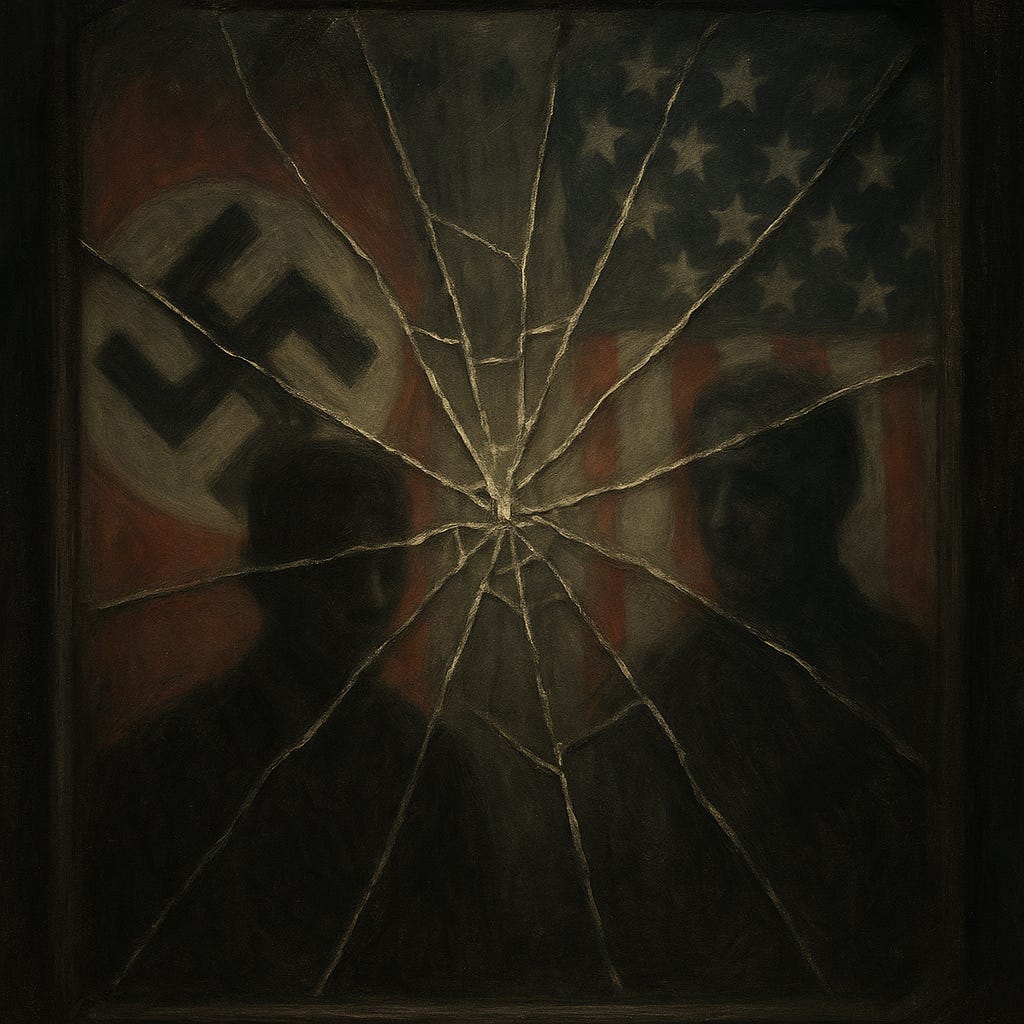
The irony is unavoidable. The same citizens who now wrap themselves in swastikas and salute a foreign dictator celebrate an ideology that would have rejected them. Hitler’s hatred did not stop with Jewish or Romani people. It included Slavs, Southern and Eastern Europeans, the Irish, Catholics, and anyone of mixed ancestry. Even many Americans of European descent would have been seen as inferior in his hierarchy.
The Nazi project was not simply nationalism taken too far. It was a hierarchy of humanity built on fear, myth, and control. Every person was assigned value based on ancestry and conformity. There was no room for liberty, dissent, or individuality, the very principles Americans claim to defend. To idolize Hitler is to misunderstand both him and oneself.
If those who glorify the Reich truly studied it, they would see their own faces reflected in its rejection. They would find themselves not in the halls of power but in the long lines of the expendable; the impure, the unwanted, the erased.
It is easy to imagine oneself as the strong in a story about domination. Harder to see that the story was never written for you.
The Lie That Needed a Uniform
Nazi ideology was not power. It was insecurity given structure. It took fear, dressed it in precision, and called it destiny. The movement promised order but delivered annihilation. Its strength came not from truth but from the obedience of those too frightened to think and too eager to belong.
At its core, Nazism was an attempt to turn hierarchy into faith. It declared blood as virtue, purity as purpose, and violence as the only means to keep the lie alive. It told ordinary men they were superior by birth, then sent them to kill to prove it. That is not greatness. That is dependency; the kind that needs enemies to exist.
Its intellectuals built pseudoscience to justify murder. Its bureaucrats translated genocide into paperwork. Its soldiers claimed they were following orders. Each piece of the machine worked because it allowed the human inside to stop thinking. That was the real seduction of fascism; it relieved people of doubt.
Nazism worshiped strength while consuming it. It demanded purity from a species built on mixture, demanded loyalty from those it planned to discard, and demanded silence from those who could see it for what it was. Even at its height, it was a hollow empire, one that mistook conformity for unity and cruelty for discipline.
It collapsed because every lie eventually reaches its natural limit. You can build a state on fear, but you cannot sustain it. You can burn books, but you cannot erase the instinct to question. The ideology that promised a thousand years lasted twelve. It devoured itself exactly as all things built on hatred must.
To speak against Nazism is not moral posturing. It is recognition of pattern. Every generation produces its own small imitators; people who crave a world simple enough to sort into enemies and allies, pure and impure, winners and traitors. They think uniformity will save them from insignificance. They forget that fascism never saves. It only consumes.
The Nazi dream was not destroyed in Berlin. It was exposed. The photographs, the testimonies, the quiet faces of the dead all remain to remind us what happens when myth replaces empathy and pride replaces truth.
The ideology dies every time someone refuses to kneel to it and it revives every time someone mistakes cruelty for conviction.
The only real antidote is memory sharpened into understanding.
TOW
History doesn't repeat; it warns.
To tow against that current is not a political act; it is human maintenance. It is remembering that fear has a uniform but courage does not. The lesson isn’t just that fascism kills. It’s that it always begins as cowardice dressed as pride.