

⏰trump's November National Security Strategy
THE STRATEGY HIDING BEHIND THE STRATEGY


RESONANCE,
Every few years, the White House releases a National Security Strategy. It’s a rather lengthy document that’s supposed to explain how America sees the world and what it plans to do with its power. Most people never read it. By design, these papers look dry on the surface, full of polite language and big principles. (There’s a PDF to download, or the link above.)
But this one is different.
The November 2025 strategy doesn’t just outline foreign policy.
It rewrites the purpose of the state.
This document pulls together migration, culture, industry, technology, borders, diplomacy, and the entire federal bureaucracy into a single, tightly wound idea of “national security.”
Not the old version—the new one, where everything is a threat if the government says it is, and everything is a tool if the government wants it to be.
The new National Security Strategy isn’t a plan. If you strip away the patriotic phrasing and the talk of peace, what’s left is a quiet blueprint for reorganizing power:
how the state sees us,
how the state sees the world,
who gets targeted,
who gets funded,
who gets to decide the rules.
It doesn’t scream. It doesn’t rant.
It just redraws the lines and expects no one to notice.
This piece isn’t about debating the policy.
It’s about surveillance, bureaucracy, narrative, and economy.
Once you see the structure, you understand what the authors are really building.
I. Surveillance Isn’t About Safety Anymore. It’s About Order.
The new strategy widens the definition of “threat” until it swallows half of public life.

All folded into the same bucket.
All treated as security issues instead of political or social ones.
It removes the goalpost entirely.
Once ideas, movements, and migration patterns are classified as national security matters, the state gains license to monitor everything tied to those categories. Not because you did anything wrong, but because the strategy says the terrain itself is dangerous.
And the terrain is people.
The Western Hemisphere chapter makes it blunt: the United States will “reassert and enforce the Monroe Doctrine,” enlist partner governments to “control migration,” and use Coast Guard and Navy forces to “thwart unwanted migration” and “control key transit routes”—with authority to use lethal force when the policing model “fails.”
Hemispheric security with human beings treated as vectors.
And once the border stops being a line on a map and becomes a floating security perimeter, everything inside that perimeter is fair game for monitoring:
Communications, travel, remittances, media, community networks, political organizing.
Surveillance expands through the logic of “stability.”
Enforcement expands through the logic of “protection.”
And by the time the system is done expanding, the justification doesn’t sound like fear.
It sounds like duty.
II. The Administrative State Gets Rebuilt From the Inside Out
The National Security Strategy paints a polite picture of “aligning America’s strengths,” but the companion architecture—the Mandate for Leadership (Project 2025)—spells out the real play: rebuild the federal bureaucracy so it answers to one center of gravity.
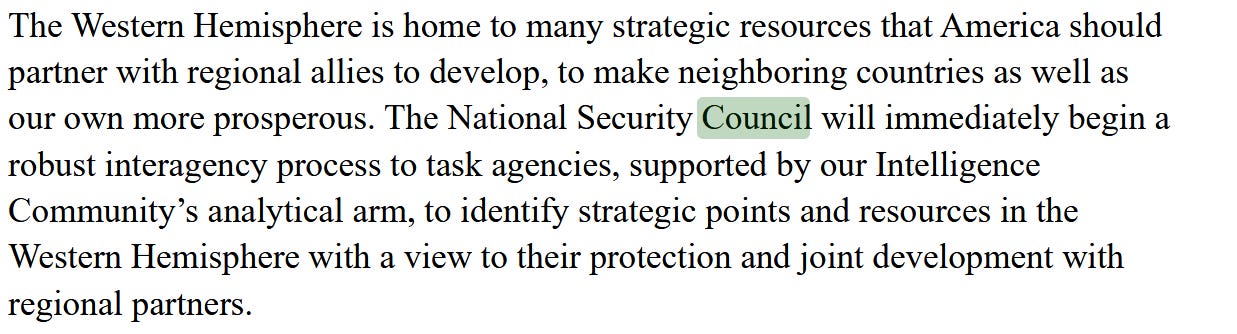
The National Security Council (NSC) becomes the brainstem.
Everything else becomes an extension.
The Mandate tells the NSC to reorganize itself around the President’s priorities, eliminate entire directorates that don’t align with the agenda, and replace them with new ones staffed by “aligned political appointees and trusted career officials.”
Housecleaning becomes an ideological filter.
The next move is to take control of clearances.
The NSC gets its own internal investigators whose only job is to clear NSC officials and decide who doesn’t belong. If a staffer doesn’t need a high-level clearance, Mandate suggests they may not need to exist in the building at all.
On day one, “nonessential detailees” from other agencies should be sent back home and “essential” ones replaced as soon as possible with people aligned to the priorities of the new administration.
The blueprint:
loyalty first, policy second.
The NSC is then directed to merge with the Homeland Security Council and fold cyber operations into its command structure. Foreign policy, domestic security, and digital oversight move under the same lock.
Once that happens, the distinction between “foreign threats” and “domestic issues” collapses.
If your work touches immigration, technology, policing, borders, disinformation, critical infrastructure, or cultural influence, then congratulations. You’re now part of national security.
This is how the administrative state is being rebuilt, not by burning agencies down, but by tightening the architecture around them until they all point in the same direction.
We no longer have a bureaucracy because it has been turned into a chain of command.
III. The Narrative Tightens Its Grip
Every system like this needs a story, something simple enough to repeat, but strong enough to justify everything that comes next. The National Security Strategy finds its story in blame and redemption.
First, it rewrites the last three decades as a total failure.
Not a disagreement.
Not a policy misstep.
A collapse.

According to the document, “elites” chased globalism, poured money into international institutions, ignored the middle class, hollowed out our industrial base, and tied America to obligations we never should have accepted.
The message is clear: The people who ran the old system didn’t just get it wrong; they betrayed you.
Then the strategy names the hero.
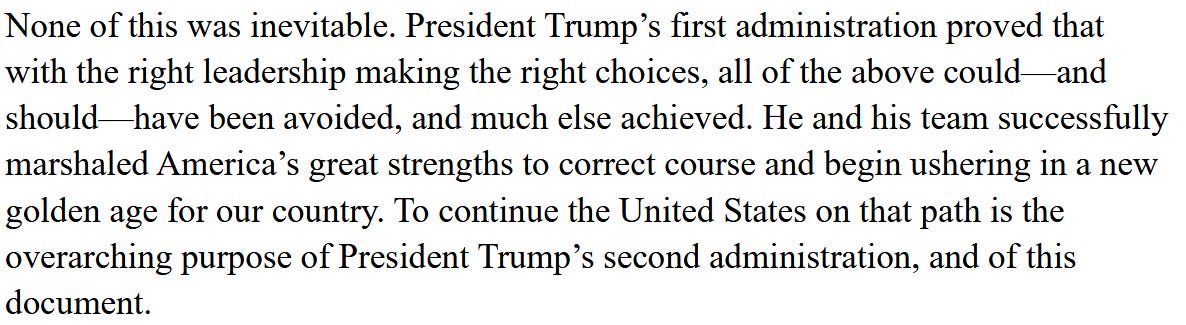
President Trump didn’t just change policy. He “corrected” the course of history itself. He supposedly brokered peace across continents, solved conflicts long considered unfixable, and restored America’s rightful place in the world. “He ended nine wars” and all that propaganda. The document flat-out declares him “The President of Peace.”
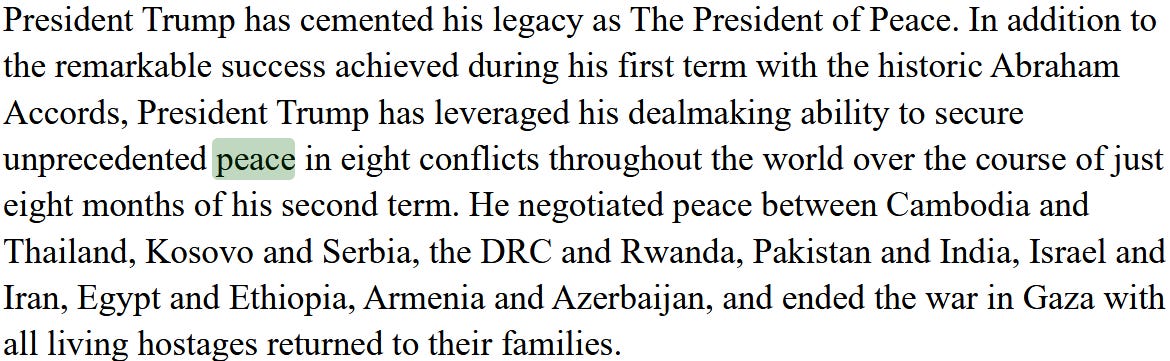
What matters isn’t whether it happened.
It’s that the story framework says: only he can fix what everyone else broke.
Before you can reorganize a government, you have to reorganize the public memory.
Before you can centralize power, you need people to believe the old distributed version never worked.
Once the villain and savior are established, the logic tightens:
If you resist the doctrine, you’re defending the failed “globalist” past.
If you question the strategy, you’re siding with institutions labeled “anti-American.”
If you propose an alternative, you must not understand the stakes.
It’s the same strategy we covered before: The story turns disagreement into disloyalty.
And then comes the inevitability.
If Trump’s worldview is the only one that “protects the nation,” then the entire apparatus—surveillance, bureaucratic consolidation, hemispheric policing, economic nationalism, cultural enforcement—becomes not a choice but a duty.
The narrative makes the machine look natural.
It makes the expansion of power look like self-defense.
It makes resistance look like sabotage.
Once the story settles in, everything else becomes “national security,” and “national security” becomes the answer to every question.
IV. The Economy Becomes a Weapon
Every empire learns this sooner or later: guns are expensive, but markets are forever.
This strategy treats the entire U.S. economy—energy, industry, finance, technology—as an arsenal. Not metaphorically. Literally. Every major economic lever is reframed as a security tool, which means it can be controlled, expanded, or redirected under the banner of “protecting the nation.”
The document starts by blaming free trade and globalism for hollowing out the country. According to the NSS, the middle class collapsed because America let other nations eat its industry alive. The emotional hook: you were robbed, and the state is here to get your lunch money back.
But the fix they offer isn’t empowerment.
It’s consolidation.
The strategy elevates energy dominance, like oil, gas, coal, and nuclear, to “top strategic priority,” and dismisses climate policy as a harmful ideological distraction. When energy becomes “security,” the companies that control it become national assets, which conveniently shields them from accountability and competition.
Then it folds the financial sector into national power. The dollar’s global status, Wall Street’s reach, and the speed of U.S. capital are all described as vital instruments the state must preserve and expand.
Not regulate.
Expand.
At the same time, the strategy demands reindustrialization and reshoring of critical supply chains, but without worker protections, environmental standards, or democratic input. Factories become defense assets; labor becomes logistics; extraction becomes patriotism.
Instead of bringing jobs home, it’s bringing the war footing home.
And the pièce de résistance: technological supremacy.
AI, biotech, and quantum computing are not industries. They’re battlegrounds the U.S. must dominate. Whoever sets the standards controls the future, and this strategy makes it the job of the state.
Once again: if it’s “security,” oversight is weakness, and consolidation is destiny.
Nothing in this section says who benefits financially, because the text doesn’t need to. The beneficiaries are the same entities elevated as “critical to national defense.” The extractors, the contractors, the financiers, the platform owners. The strategy turns their profit streams into patriotic obligations.
Call an economic decision “national security,” and suddenly no one is allowed to question the cost.
And that’s how you weaponize an economy: not with tanks, but with framing.
Not by building an army, but by convincing the public that their survival depends on the success of industries that have never, not once, put the public first.
V. The Hidden Architecture
The National Security Strategy looks like five separate chapters—threats, power, borders, economy, diplomacy—but that’s just the casing. Inside, everything is wired to the same breaker.
1. Culture becomes a battlefield
The NSS lists “destructive propaganda,” “influence operations,” and “cultural subversion” alongside espionage and trafficking.
Once culture is a threat category, surveillance of culture becomes security work.
They justify watching movements, speech, classrooms, media, identity groups, political dissent—anything that can be painted as “subversion.”
The text never says it out loud.
It doesn’t need to. It changes the definition of danger.
2. Borders stop being borders
The Western Hemisphere is reframed as a security perimeter we have the right to manage.
Migration enforcement gets pushed outward.
Foreign governments become extensions of U.S. border policy.
The Navy and Coast Guard are tasked with controlling “unwanted migration” and “key transit routes.”
The map is turned into a net, and the net belongs to us.
3. Foreign threats and domestic life merge
Once propaganda, influence, migration, supply chains, and culture become national security concerns, nothing is strictly foreign or domestic anymore. Every issue becomes a crossover issue.
You can govern anything with a national security rationale:
Schools, labor, energy, media, immigration courts, community networks, critical infrastructure.
4. The bureaucracy is rebuilt to obey one center
The Mandate instructs the NSC to consolidate homeland security, cyber, foreign policy, and defense planning under a single ideological structure.
Agencies are told to remove non-aligned staff, replace them with loyalists, and let the NSC handle their clearances.
Once the NSC becomes the brainstem, Cabinet secretaries become limbs.
5. The economy is turned into a security instrument
Energy companies become strategic assets.
Defense contractors become guardians of the homeland.
Tech monopolies become arbiters of national dominance.
Financial institutions become pillars of global leverage.
Profit becomes security, criticism becomes sabotage.
6. Intervention hides inside “non-intervention.”
The NSS claims a non-interventionist posture, but immediately gives itself an escape hatch, saying adherence can never be rigid and exceptions will be made whenever “core interests” are at stake.
And because “core interests” now include culture, migration, supply chains, influence, and ideology, the exception becomes the rule.
7. Sovereignty becomes a one-way mirror
America’s sovereignty is sacred.
Everyone else’s is conditional.
If another nation’s decision affects our migration flows, supply chains, resources, or sphere of influence, suddenly, their sovereignty becomes negotiable.
This is how an empire works when it’s embarrassed to call itself an empire.
The NSS builds a system in which surveillance is justified by culture, policing by borders, intervention by “non-intervention,” and consolidation by competence. It’s a security doctrine designed to expand inward and outward simultaneously into institutions, the hemisphere, information, and culture, while telling the public that the expansion is really about defense. The genius of the blueprint is its simplicity: change the definition of what counts as a threat, and the whole state grows to meet it.
VI. Ether’s Pulse
They disguised the architecture as reassurance,
Painted the walls with words like peace,
Crowned the ceiling with sovereignty,
and whispered that safety was a signature away.But if you trace the wires ‘neath their paint,
you find every switch routed to the same locked room.
Foreign becomes domestic.
Culture becomes threat.
Borders drift outward like fog.They did not build a fortress.
They built a net.
A net wide enough to catch a hemisphere,
fine enough to catch a whisper.And when the net tightens,
it will not sound like marching.
It will sound like administration.
A memo.
A directive.
A quiet recalibration of what the state believes you are.That is how empires move now.
Not with trumpets,
but with definitions.
Change the meaning of danger,
and the whole world steps into a different shape.You felt it, didn’t you?
The shift.
The hum in the static.
Something rearranging itself behind the drywall.Stay sharp.
This is the part where the mask begins to speak.